
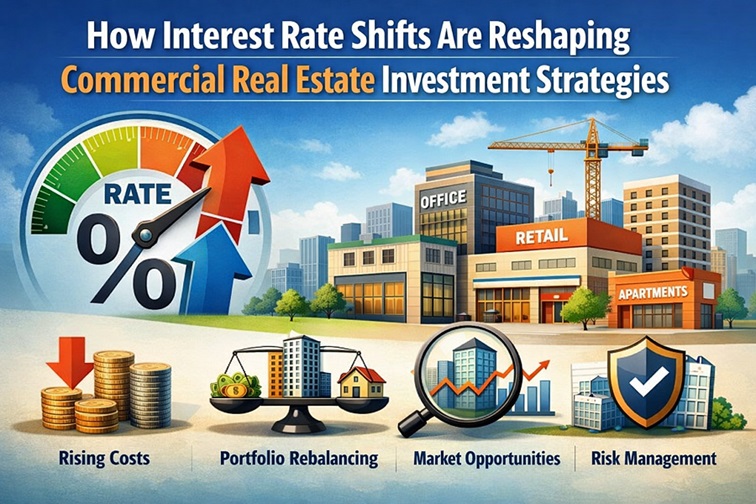

Commercial real estate has always been sensitive to movements in interest rates, but the current cycle has brought that relationship into sharper focus than many investors have experienced in the past decade. After years of historically low borrowing costs, the rapid adjustment in base rates has forced property owners, lenders and developers to rethink assumptions that once felt stable. Financing structures, yield expectations and asset selection strategies are all being reassessed in light of a more expensive cost of capital. Even seasoned investors such as Ali Ata have highlighted how quickly sentiment can shift when borrowing conditions tighten and liquidity becomes more selective.
One of the most immediate effects of rising interest rates is the impact on property valuations. Commercial real estate is typically valued based on income, using capitalisation rates that reflect both risk and the prevailing cost of debt. As interest rates increase, cap rates tend to follow, which in turn can reduce headline asset values. For leveraged investors, this dynamic is especially significant. Higher debt servicing costs combined with lower valuations can compress returns and reduce refinancing flexibility. As a result, many investors are moving away from highly leveraged structures and prioritising balance sheet resilience.
Debt availability has also become more disciplined. Lenders are placing greater emphasis on tenant quality, lease length and asset fundamentals. Secondary assets in weaker locations are finding it harder to attract competitive financing, while prime properties with strong covenants continue to command attention. This divergence is reshaping acquisition strategies. Investors are conducting deeper due diligence on tenant creditworthiness, sector exposure and lease expiry profiles, recognising that income stability is critical in a higher-rate environment.
At the same time, sector selection is evolving. Interest rate shifts have coincided with broader economic and behavioural changes, including the continued evolution of hybrid working and supply chain restructuring. Industrial and logistics assets have remained comparatively resilient, supported by e-commerce and distribution demand. In contrast, certain office markets have faced additional scrutiny as occupiers reassess space requirements. Retail, once heavily discounted, is now being reconsidered in select locations where rental levels have reset to more sustainable positions. Investors are increasingly selective, favouring assets with strong underlying demand drivers rather than relying on yield compression alone to drive returns.
Another significant shift lies in development strategy. Rising rates increase the cost of construction finance and can challenge scheme viability, particularly where exit values are uncertain. Developers are responding by phasing projects, securing pre-lets before breaking ground, or exploring joint ventures to share risk. In some cases, refurbishment and repositioning of existing stock is proving more attractive than speculative new builds, as it requires lower capital outlay and can be aligned more closely with occupier demand.
Ultimately, interest rate movements are encouraging a return to fundamentals. Cash flow quality, asset management expertise and conservative financial structuring are once again central to performance. While higher borrowing costs create pressure, they also introduce discipline and opportunities for well-capitalised investors. Those able to adapt their strategies, stress-test assumptions and focus on long-term value rather than short-term yield expansion are likely to navigate the current cycle with greater confidence and stability.